Conditions
Heel pain
Plantar fasciitis or fasciopathy, and other causes.
You don't need imaging to message us; if you need any, we'll tell you which. Or tell us about your pain first
Pain under the heel, especially with the first steps in the morning, usually comes from the plantar fascia. When it lasts for months, it is not always inflammation: often it is tissue that stopped tolerating load. And not every heel pain is the fascia. That is why the first step is an evaluation.
What we see in clinic
- Pain on the inner side of the sole of the heel
- Sharp pain with the first steps after getting up or after sitting
- Pain that gets worse after long periods standing, walking or running
- Plantar fasciitis that has not improved with rest, insoles or anti-inflammatories
- Heel pain from other causes: stress fracture of the calcaneus, fat pad syndrome, nerve entrapment or a plantar fibroma
How it is assessed
History
How long it has hurt, activity, work, footwear and what has already been tried.
Exam
Painful point, ankle mobility, calf tightness, foot strength and how the foot lands.
Ultrasound
Thickness and fibers of the fascia, its attachment to the heel and other causes of pain.
Plan
Load adjustment and exercise; an ultrasound-guided injection only if indicated.
First, the foundation
An injection is not the first step. What helps most at the start is working on load and tissue capacity:
- Adjusting everyday loads (hours standing, sport, footwear)
- Stretching the plantar fascia and the calf
- Strengthening the foot and ankle with progressive exercise
- Taping, insoles or a night splint in some cases
The goal is not only less pain, but changing what keeps the injury going.
Treatments that may be considered
If the pain persists despite these measures, and only if indicated, an injection can be done with the needle guided by ultrasound:
- Corticosteroid (ultrasound-guided injection): relieves pain faster but does not repair the tissue. It is not repeated without limits, because it has been linked to rupture of the fascia.
- Prolotherapy: aims to stimulate tissue repair. It usually takes several sessions and may hurt for a few days afterward.
- Platelet-rich plasma (PRP): a concentrate of your own platelets; usually one to three injections.
- Joint work with rehabilitation
What the evidence says about each one, in the article Plantar fasciitis or fasciopathy.
What we do not promise
Results vary. An injection does not correct, on its own, the load that caused the injury: it goes along with exercise, it does not replace it. If the pain comes from another cause, such as a stress fracture, it is treated or referred as appropriate. Surgery is reserved for the few cases that do not improve after months of treatment; if that is your case, you are referred to orthopedics.
In summary
In two slides by Dr. Lizeth Ortiz:
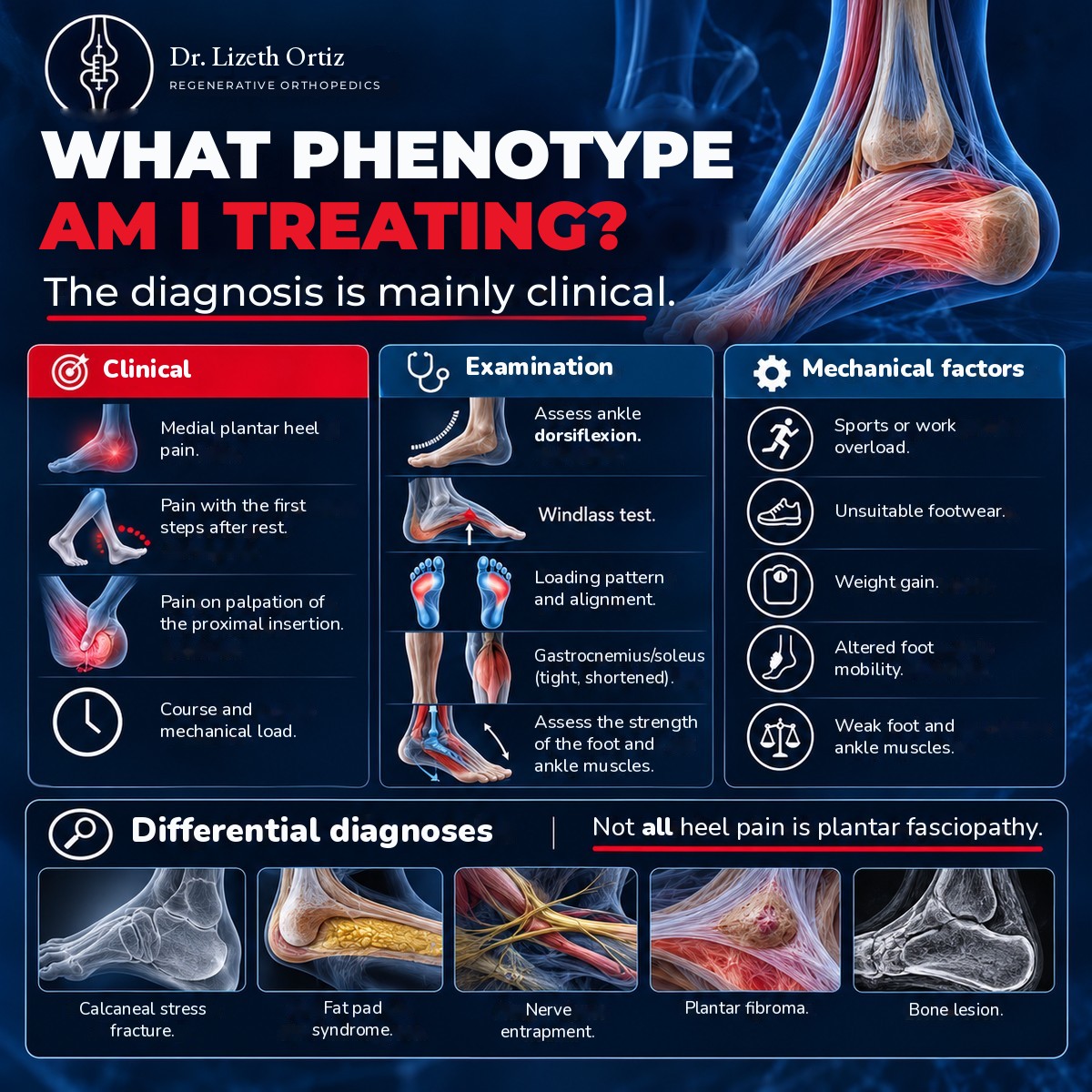 Slide 1 of 2
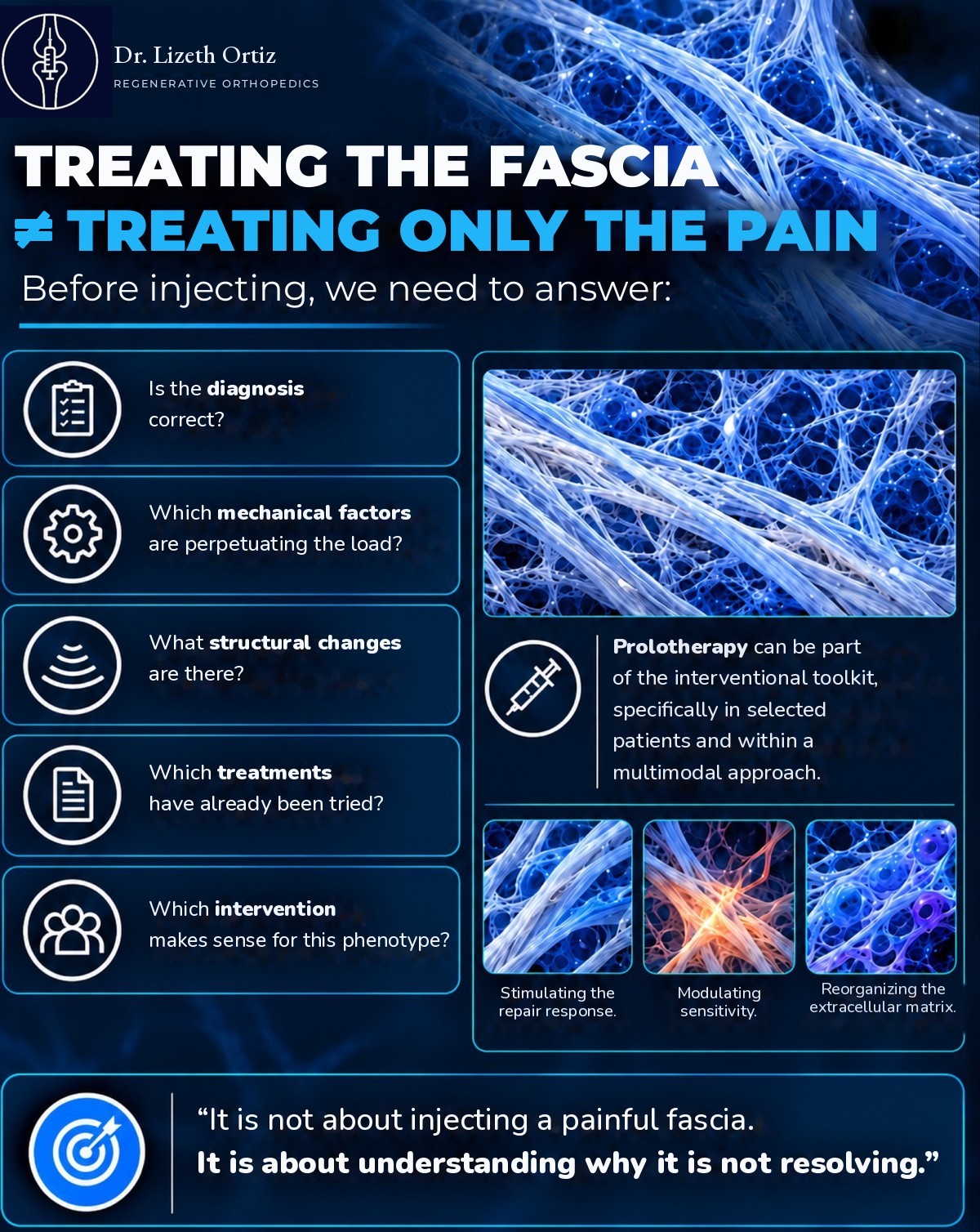 Slide 2 of 2
Frequently asked questions
What imaging do I need for the evaluation?
Ideally, X-rays of the painful area (knee, hip, shoulder, spine or other) taken within the last year. If you already have an MRI or ultrasound, those help too: share them on WhatsApp before your visit. If you do not have recent imaging, we tell you which studies to get before booking.
Why do you use ultrasound?
Ultrasound makes it possible to see the structure being treated and to guide the needle with greater precision. It helps the procedure be performed more safely and accurately.
Does the injection hurt?
Local anesthetic is used to reduce discomfort during the procedure. Even so, you may feel pressure, contact or mild discomfort. Before starting, we explain what you may feel and what aftercare to follow. Ultrasound allows the procedure to be done with greater precision, although it does not completely remove the sensation of the needle.
Do I have to come in to find out whether this treatment is right for me?
Not necessarily. We know that getting around can be hard when you are in pain or have limited mobility. With your symptoms and your imaging, we can guide you on WhatsApp about whether a visit makes sense. That guidance is not a consultation or a diagnosis: the treatment decision is made at the consultation, after the physical exam.
How much does the consultation cost? And the treatment?
The evaluation visit costs MXN $500 (Mexican pesos). Treatment (prolotherapy, viscosupplementation, injections or another procedure) has no fixed price: it depends on the area, the procedure and the number of sessions you need, which are decided at your evaluation. Before starting, we tell you the cost of your plan.
Further reading
Book a visit
Care in Guadalajara and Mexico City, by appointment.
Guadalajara: Bari Medical Center, San Juan de Los Lagos 21, Vallarta Poniente, 44110 Guadalajara, Jalisco, Mexico. Monday through Saturday.
Mexico City: Medical San Francisco, Rosa María Siqueiros 229, San Francisco Culhuacán, Coyoacán, 04420 Mexico City, Mexico. One week a month; ask us for the dates on WhatsApp.
You don't need imaging to message us; if you need any, we'll tell you which.
Want to tell us about your case first? Answer a few questions about your pain