
Blog
Plantar fasciitis or fasciopathy: what the evidence says
“Plantar fasciitis” is the best-known name for pain under the heel. In cases that last for months, what is found in the fascia looks less like inflammation and more like tissue that stopped tolerating load. That is why it is increasingly called fasciopathy, and why treatment is not limited to reducing inflammation.
Fasciitis or fasciopathy?
The plantar fascia is a thick band of tissue that runs from the heel to the base of the toes and supports the arch of the foot. “Fasciitis” means inflammation of the fascia. But when tissue from people with months of pain is studied, something else shows up: disorganized collagen fibers, a thicker fascia, changes in the surrounding tissue and blood vessels, and few inflammatory cells.
That is why it is called fasciopathy: tissue that became disorganized because the load it receives exceeds what it can tolerate. The name matters because it changes the plan. If it were all inflammation, reducing it would be enough. In a chronic case, the tissue also needs to regain its capacity to bear load.
How it is diagnosed
The diagnosis is mainly clinical. The typical picture is:
- Pain on the inner side of the sole of the heel.
- Pain that is worse with the first steps after getting up or after sitting.
- Pain when pressing where the fascia attaches to the heel bone.
The exam checks how far the ankle bends upward, whether the calf is tight or shortened, the strength of the foot and ankle muscles, and how the foot lands. It also looks for what increases the load: more activity or sport, long hours standing, unsuitable footwear or weight gain.
Not every heel pain is the fascia. Other causes that are ruled out are a stress fracture of the calcaneus, heel fat pad syndrome, nerve entrapment, a plantar fibroma or other bone lesions.
What ultrasound can show
Ultrasound is not only for guiding the needle. In the plantar fascia it helps to see:
- Thickness. Near the heel, a fascia thicker than 4 mm is considered thickened; in people with chronic pain it is usually about 2 mm thicker than in people without pain.
- Darker areas (hypoechoic) and loss of the orderly fiber pattern.
- Changes where the fascia attaches to the bone (the enthesis) and, sometimes, more blood vessels on Doppler.
That information complements the exam, helps rule out other causes and, if an injection is done, lets the needle be seen at all times.
First, the foundation
An injection is not the first step. The most recent clinical practice guideline for heel pain recommends starting with load, tissue capacity and biomechanics:
- Education and adjusting everyday loads.
- Specific stretching of the plantar fascia and the calf.
- Progressive exercise and strengthening of the foot and ankle.
- Manual therapy or taping when indicated.
- Insoles or orthoses, and a night splint, in some patients.
The goal is not only less pain, but changing the mechanical environment that keeps the injury going. Many people improve with these measures alone.
When it does not improve: what the options are
Before considering an injection, it helps to answer:
- Is the diagnosis correct?
- Which mechanical factors are still loading the fascia?
- What changes are there in the tissue?
- Which treatments have already been tried, and how?
- Which intervention makes sense for this particular case?
The most studied options:
| What the evidence says | Keep in mind | |
|---|---|---|
| Corticosteroid (steroid) | A potent anti-inflammatory. It relieves pain faster in the first weeks. At 3 and 6 months, platelet-rich plasma gives better pain results, and shock waves at 6 months. | It relieves pain but does not repair the tissue. Most reported plantar fascia ruptures happened after corticosteroid injections, which is why it is not repeated without limits. |
| Prolotherapy (dextrose) | A solution that triggers a controlled repair response. Compared with a saline injection, it improves pain and function in the medium term, with low-certainty evidence. In the short term, corticosteroid relieves more. | Pain may increase for a few days after the injection. It usually takes several sessions. |
| Platelet-rich plasma (PRP) | A concentrate of platelets from your own blood. In a meta-analysis of 21 studies, it reduced pain more than corticosteroid, shock waves and placebo, and improved function more than corticosteroid and placebo. The difference from shock waves at 3–6 months is small. | Usually one to three injections. Response varies and the way it is prepared is not standardized. It costs more. |
| Shock waves | Mechanical waves applied from outside the skin, without a needle. In plantar fasciopathy they are effective and well tolerated for pain. | They can be uncomfortable during the session and are not offered everywhere. |
None is for everyone. The choice depends on how long the pain has lasted, the load on the foot, what the exam and ultrasound show, and what each patient wants. In every case, the injection goes along with exercise and load adjustment; it does not replace them.
In summary
Two slides by Dr. Lizeth Ortiz on this topic. The images in the second one are illustrations, not ultrasound scans of patients.
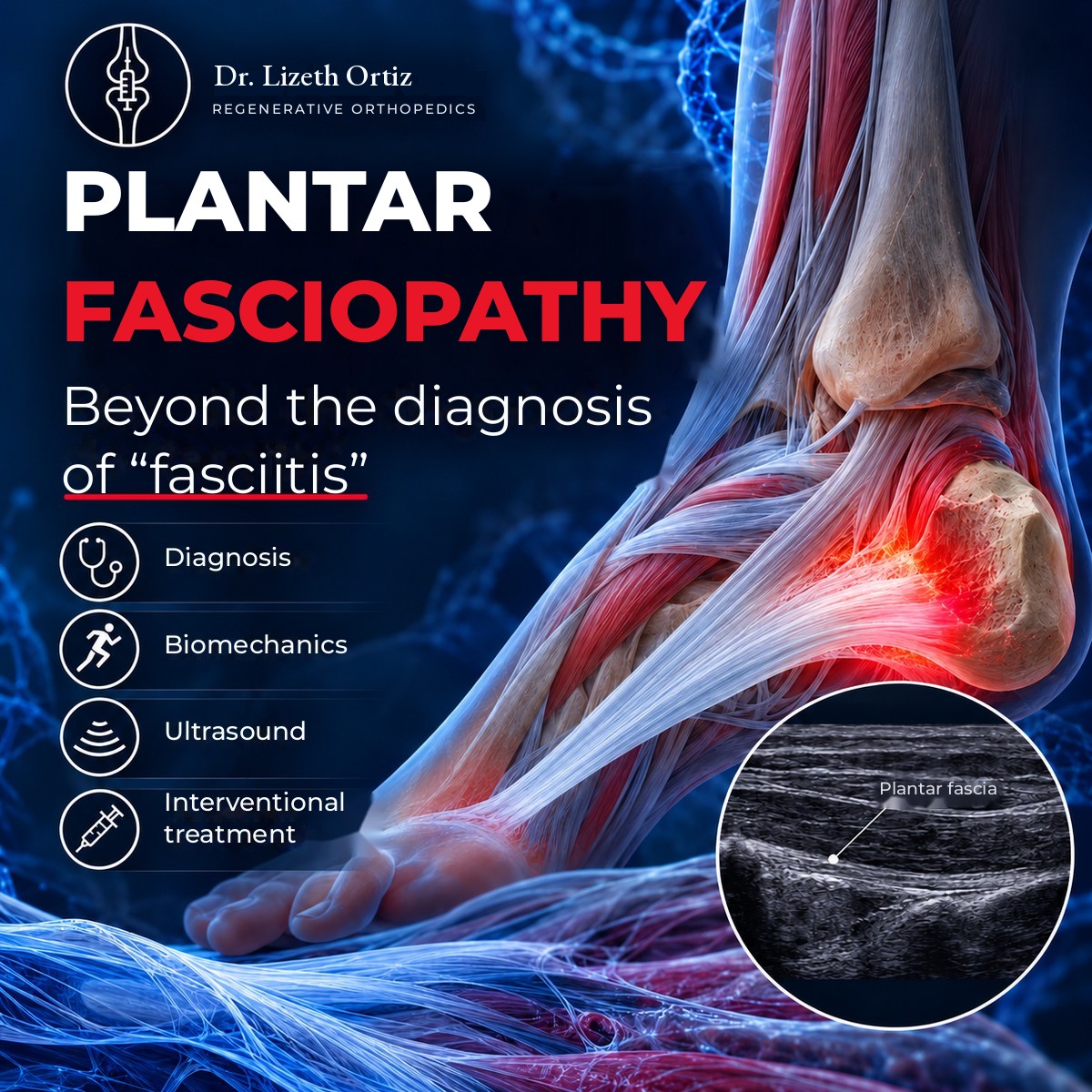 Slide 1 of 2
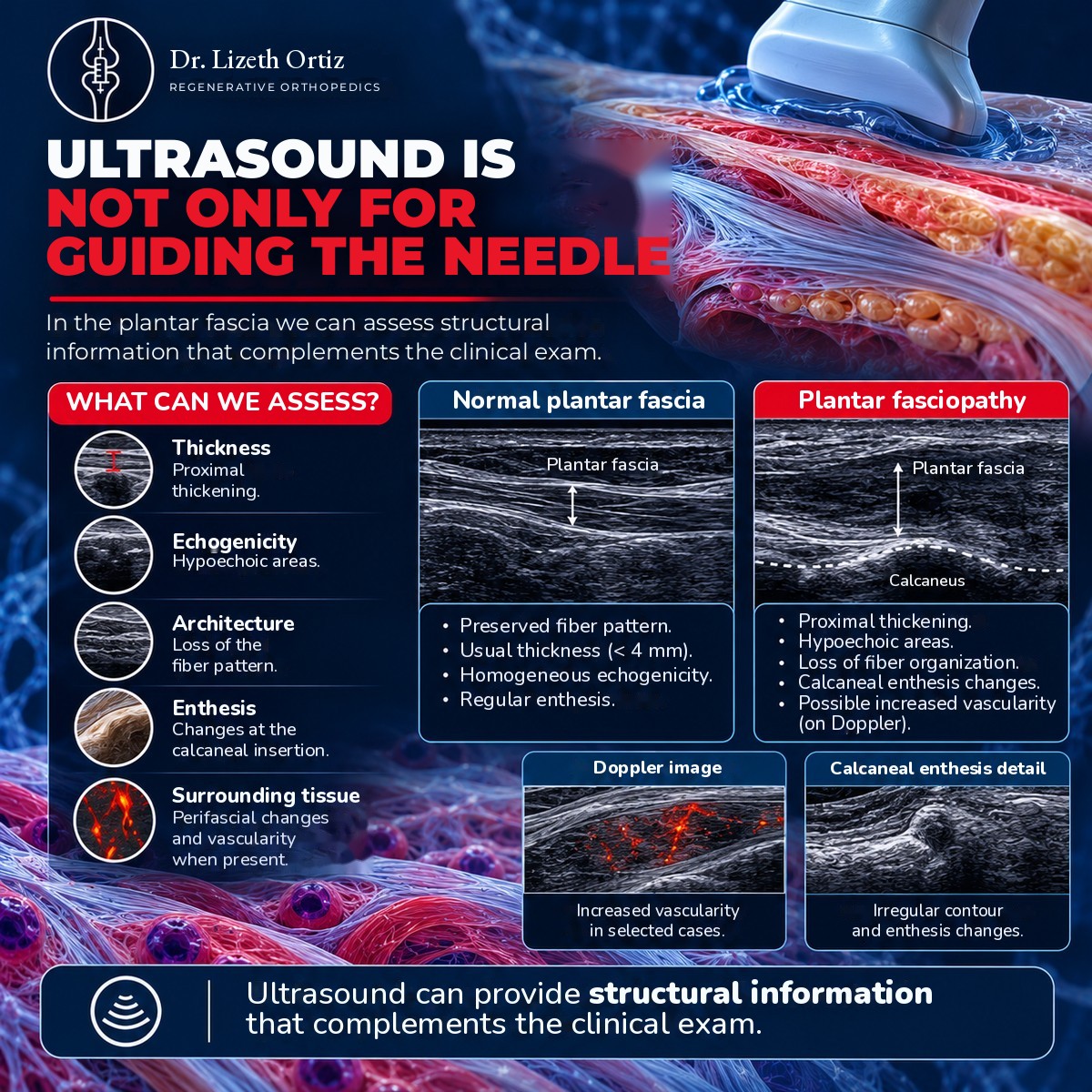 Slide 2 of 2
If your heel hurts
Heel pain explains how we assess it and which treatments we offer. More about each procedure: prolotherapy, platelet-rich plasma and ultrasound-guided injections.
Educational. It does not replace an individual medical evaluation. Results vary.
References (9)
- Koc TA Jr, Bise CG, Neville C, Carreira D, Martin RL, McDonough CM. Heel pain – plantar fasciitis: revision 2023. J Orthop Sports Phys Ther. 2023;53(12):CPG1-CPG39. Read the source
- Lemont H, Ammirati KM, Usen N. Plantar fasciitis: a degenerative process (fasciosis) without inflammation. J Am Podiatr Med Assoc. 2003;93(3):234-237. Read the source
- McMillan AM, Landorf KB, Barrett JT, Menz HB, Bird AR. Diagnostic imaging for chronic plantar heel pain: a systematic review and meta-analysis. J Foot Ankle Res. 2009;2:32. Read the source
- The role of corticosteroid injections in treating plantar fasciitis: a systematic review and meta-analysis. Foot (Edinb). 2023;54:101970. Read the source
- Mosca M, Fuiano M, Massimi S, Censoni D, Catanese G, Grassi A, Caravelli S, Zaffagnini S. Ruptures of the plantar fascia: a systematic review of the literature. Foot Ankle Spec. 2020. Read the source
- Fong HPY, Zhu MT, Rabago DP, Reeves KD, Chung VCH, Sit RWS. Effectiveness of hypertonic dextrose injection (prolotherapy) in plantar fasciopathy: a systematic review and meta-analysis of randomized controlled trials. Arch Phys Med Rehabil. 2023;104(11):1941-1953.e9. Read the source
- Herber A, Covarrubias O, Daher M, et al. Platelet rich plasma therapy versus other modalities for treatment of plantar fasciitis: a systematic review and meta-analysis. Foot Ankle Surg. 2024;30(4):285-293. Read the source
- Daher M, Covarrubias O, Herber A, Oh I, Gianakos AL. Platelet-rich plasma vs extracorporeal shock wave therapy in the treatment of plantar fasciitis at 3-6 months: a systematic review and meta-analysis of randomized controlled trials. Foot Ankle Int. 2024. Read the source
- Efficacy and tolerability of extracorporeal shock wave therapy in patients with plantar fasciopathy: a systematic review with meta-analysis and meta-regression. Eur J Phys Rehabil Med. 2024;60(5):832-846. Read the source
Dr. Lizeth shares more about joint pain and regenerative medicine on social media.
Book a visit
Care in Guadalajara and Mexico City, by appointment.
Guadalajara: Bari Medical Center, San Juan de Los Lagos 21, Vallarta Poniente, 44110 Guadalajara, Jalisco, Mexico. Monday through Saturday.
Mexico City: Medical San Francisco, Rosa María Siqueiros 229, San Francisco Culhuacán, Coyoacán, 04420 Mexico City, Mexico. One week a month; ask us for the dates on WhatsApp.
Want to tell us about your case first? Answer a few questions about your pain