Conditions
Spine pain
Low back, mid-back, neck, and pain that travels down the arm or leg.
You don't need imaging to message us; if you need any, we'll tell you which. Or tell us about your pain first
Disc herniations are not sentences. They are findings that must be read in a biomechanical context. We do not treat isolated images. We treat functional segments.
The core idea
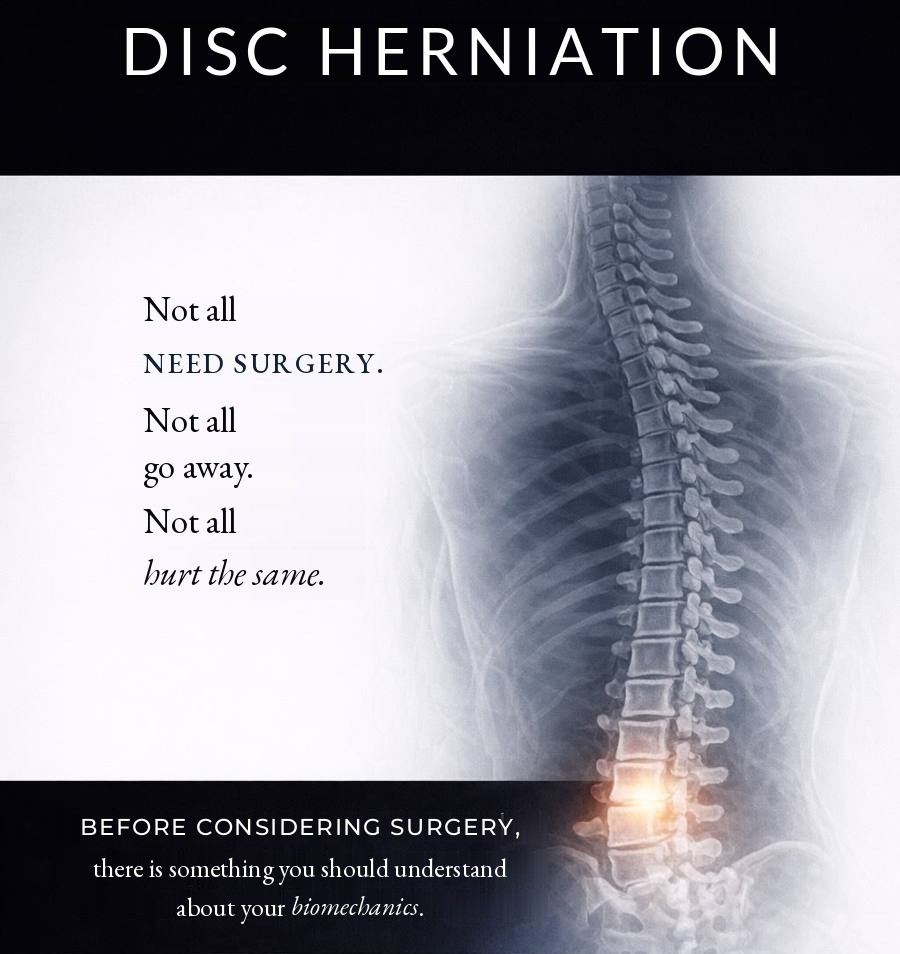
Not every disc herniation needs surgery.
Not every disc herniation disappears.
Not every disc herniation hurts the same way.
Before thinking about surgery, the biomechanics of that spine, in that patient, have to be understood.
The goal is not to “erase” a disc herniation. It is to modulate inflammation, improve stability and optimize function. Every spine is different; every patient is too.
What we assess
- Low-back, mid-back or neck pain
- Morning stiffness or pain when sitting / standing
- Pain radiating to the buttock, leg or foot (sciatica or another radiculopathy)
- Pain traveling down the arm, with or without tingling
- A history of disc herniation, protrusion or “joint degeneration” on an MRI
- Recurrence after rehabilitation or previous injections
Disc herniation
A disc herniation or protrusion on MRI is a piece of data. It is not a life diagnosis. People without pain have disc herniations; people with intense pain sometimes have modest changes.
In the visit we correlate:
- the level on the image with the territory of the pain
- neural-tension signs and strength
- segment stability (ligaments, facets, motor control)
- load factors: sitting work, lifting, sport
When there are warning signs or an injury that requires surgery, evaluation by a spine, trauma and orthopedic specialist is recommended. That is also stated at the first visit.
Radiculopathy
If pain travels down the leg or the arm, it may be a radiculopathy. Not every case needs surgery. In selected patients there are interventional and regenerative options aimed at controlling pain and improving function, always after a diagnosis.
“Sciatica” in everyday language is not one nerve and not one treatment.
Mechanical low-back and neck pain
Chronic low-back pain and neck pain from overload, held postures or segment instability are common reasons for a visit. Prolotherapy may be considered when the problem is in ligaments, entheses or stabilizers — not when a surgical indication has been left unattended.
Mechanical low-back pain can be managed; not every case becomes chronic in the same way.
Home office and compression neuropathies
Prolonged work from home, with poor posture and few breaks, can favor compression neuropathies: pain, numbness or tingling in the limbs. Ergonomics and movement matter as much as any procedure. Regenerative treatments or hydrodissection help improve pain and mobility.
Approach in clinic
History
History and warning signs.
Examination
Examination of the segment and the nerve root.
Imaging
Critical reading of the MRI, not treatment of the image.
Ultrasound
When intervention will be guided.
Plan
Education, rehabilitation, ultrasound-guided injection, prolotherapy or another protocol; or surgical referral.
What this does not promise
A disc herniation is not made to disappear with an injection. Avoiding surgery is not guaranteed. Prolotherapy is not “the solution” for every low-back pain. Results vary.
Frequently asked questions
Does every disc herniation need surgery?
Not always. Having a disc herniation on an image does not necessarily mean surgery is needed. Treatment depends on the symptoms, the physical exam and how function is affected. The goal is to reduce pain and inflammation and to improve mobility and function. When there are warning signs or an injury that requires surgery, evaluation by a spine, trauma and orthopedic specialist is recommended.
Can this help pain that travels down my leg or arm?
It may be radiculopathy or another cause. Not all of those presentations require surgery, and not all are candidates for intervention. Diagnosis comes first; options are discussed after that.
What is hydrodissection and when can it help?
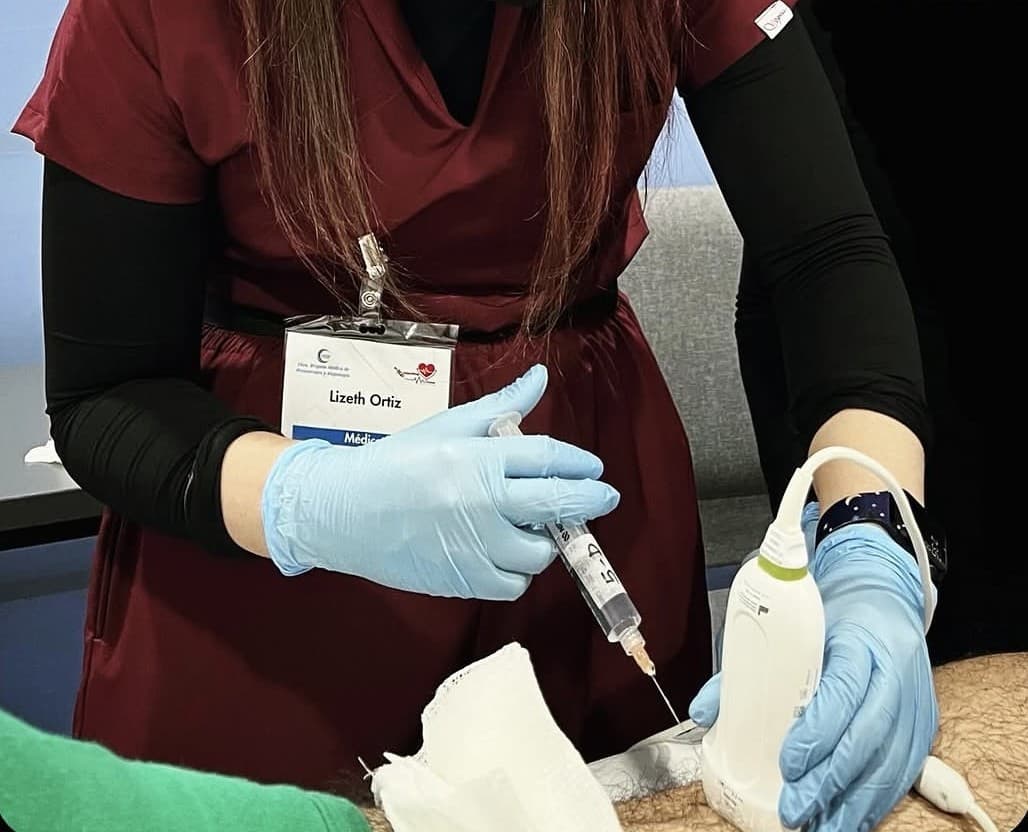
Hydrodissection is an ultrasound-guided technique. A solution is used to gently separate a nerve from the tissues around it when there is compression, adhesion or irritation. By freeing the space around the nerve, the aim is to reduce pressure and make it easier for the nerve to move. This may help ease pain, tingling or other discomfort related to nerve irritation. It may be considered in some cases of entrapment or irritation of peripheral nerves. That is always after the cause and the site of the problem have been identified. Not every case of sciatica requires hydrodissection, because treatment depends on the origin of the symptoms and on each patient’s evaluation.
What imaging do I need for the evaluation?
Ideally, X-rays of the painful area (knee, hip, shoulder, spine or other) taken within the last year. If you already have an MRI or ultrasound, those help too: share them on WhatsApp before your visit. If you do not have recent imaging, we tell you which studies to get before booking.
How much does the consultation cost? And the treatment?
The evaluation visit costs MXN $500 (Mexican pesos). Treatment (prolotherapy, viscosupplementation, injections or another procedure) has no fixed price: it depends on the area, the procedure and the number of sessions you need, which are decided at your evaluation. Before starting, we tell you the cost of your plan.
Further reading
Book a visit
Care in Guadalajara and Mexico City, by appointment.
Guadalajara: Bari Medical Center, San Juan de Los Lagos 21, Vallarta Poniente, 44110 Guadalajara, Jalisco, Mexico. Monday through Saturday.
Mexico City: Medical San Francisco, Rosa María Siqueiros 229, San Francisco Culhuacán, Coyoacán, 04420 Mexico City, Mexico. One week a month; ask us for the dates on WhatsApp.
You don't need imaging to message us; if you need any, we'll tell you which.
Want to tell us about your case first? Answer a few questions about your pain