Treatments
Platelet-rich plasma (PRP)
Growth factors obtained from the patient's own blood.
You don't need imaging to message us; if you need any, we'll tell you which. Or tell us about your pain first
Platelet-rich plasma (PRP) is an orthobiologic treatment: it is obtained from a sample of the patient's own blood, the platelet-rich portion is concentrated and applied to the area being treated. Platelets contain growth factors, substances involved in tissue repair. It is not surgery. It does not replace an evaluation.
What it aims for
- Stimulating the repair of cartilage, tendons, ligaments and muscle
- Modulating inflammation
- Supporting the recovery of function as part of a regenerative plan
When it may be considered
- Sports injuries of tendons, ligaments or muscle
- Joint degeneration
It can be applied in the knee, hip, shoulder, ankle, plantar fascia, elbow and wrist. Whether it is indicated, and where, is decided during the evaluation. More about knee, shoulder, hip and heel pain.
With prolotherapy
Sometimes they are combined: growth factors inside the joint and prolotherapy outside it, to strengthen the ligaments and tendons that provide stability.
How it is done
Evaluation
History, physical exam and imaging to decide whether PRP makes sense and where.
Sample
A blood sample is taken from the patient.
Preparation
The blood is processed to concentrate the platelets.
Application
It is applied to the indicated area, with local anesthesia and, when needed, ultrasound guidance.
Afterwards
Activity instructions for the following hours and days.
Sessions
The number of sessions depends on each patient and on how severe the condition is. It is defined during the visit, in a personalized protocol.
Before and after
There is no rule to stop medications, but before the procedure let us know which ones you take (including anti-inflammatories and blood thinners), and whether you have a bleeding disorder or allergies, so the doctor can advise case by case.
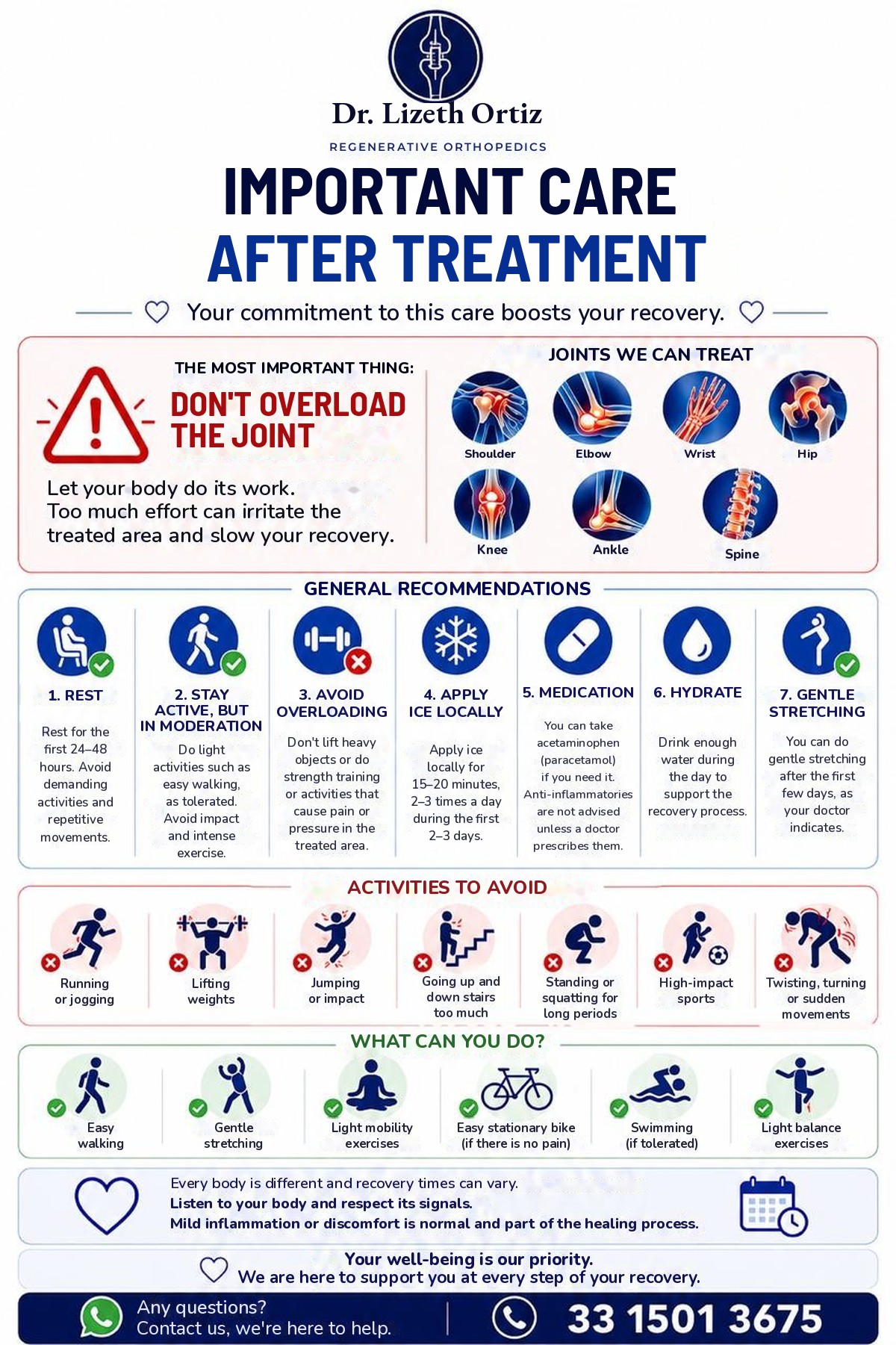
Afterward, the most important thing is not to overload the joint: too much effort can irritate the treated area and slow recovery.
- Rest for the first 24–48 hours. Avoid demanding activities and repetitive movements.
- Stay active, but in moderation: light activities such as easy walking, as tolerated.
- Avoid overloading the area: lifting weights, strength training, running, jumping or impact, going up and down stairs too much, standing or squatting for long periods, high-impact sports, and twisting or sudden movements.
- Apply ice locally for 15–20 minutes, 2–3 times a day during the first 2–3 days.
- You can take acetaminophen (paracetamol) if you need it. Anti-inflammatories are not recommended unless a doctor indicates them.
- Drink enough water during the day.
- After the first few days, gentle stretching as your doctor indicates, and, if there is no pain, a stationary bike at an easy pace, swimming, and light mobility and balance exercises.
A mild inflammation or discomfort is normal. Every body is different and recovery times vary. If fever, redness, significant warmth or swelling appear, or severe pain that gets worse as the days go by, seek medical attention right away.
In short, in an infographic by Dr. Lizeth Ortiz:
 View larger
What it does not promise
It does not guarantee cartilage regeneration or avoiding surgery when surgery is already indicated. Results vary with the injury, how long it has been present and each person.
Frequently asked questions
Are results guaranteed?
No. Results vary depending on the person, the tissue and what has already been tried. Expectations are reviewed honestly during the consultation.
How many sessions will I need?
There is no fixed number. Tissue repair happens in phases; a chronic injury is not resolved in a single visit. The plan and the follow-up are defined case by case. Follow-up matters as much as the procedure itself.
Does the injection hurt?
Local anesthetic is used to reduce discomfort during the procedure. Even so, you may feel pressure, contact or mild discomfort. Before starting, we explain what you may feel and what aftercare to follow. Ultrasound allows the procedure to be done with greater precision, although it does not completely remove the sensation of the needle.
Do I have to come in to find out whether this treatment is right for me?
Not necessarily. We know that getting around can be hard when you are in pain or have limited mobility. With your symptoms and your imaging, we can guide you on WhatsApp about whether a visit makes sense. That guidance is not a consultation or a diagnosis: the treatment decision is made at the consultation, after the physical exam.
How much does the consultation cost? And the treatment?
The evaluation visit costs MXN $500 (Mexican pesos). Treatment (prolotherapy, viscosupplementation, injections or another procedure) has no fixed price: it depends on the area, the procedure and the number of sessions you need, which are decided at your evaluation. Before starting, we tell you the cost of your plan.
Book a visit
Care in Guadalajara and Mexico City, by appointment.
Guadalajara: Bari Medical Center, San Juan de Los Lagos 21, Vallarta Poniente, 44110 Guadalajara, Jalisco, Mexico. Monday through Saturday.
Mexico City: Medical San Francisco, Rosa María Siqueiros 229, San Francisco Culhuacán, Coyoacán, 04420 Mexico City, Mexico. One week a month; ask us for the dates on WhatsApp.
You don't need imaging to message us; if you need any, we'll tell you which.
Want to tell us about your case first? Answer a few questions about your pain