MSK intervention
Ultrasound-guided injections
Musculoskeletal intervention under ultrasound guidance.
You don't need imaging to message us; if you need any, we'll tell you which. Or tell us about your pain first
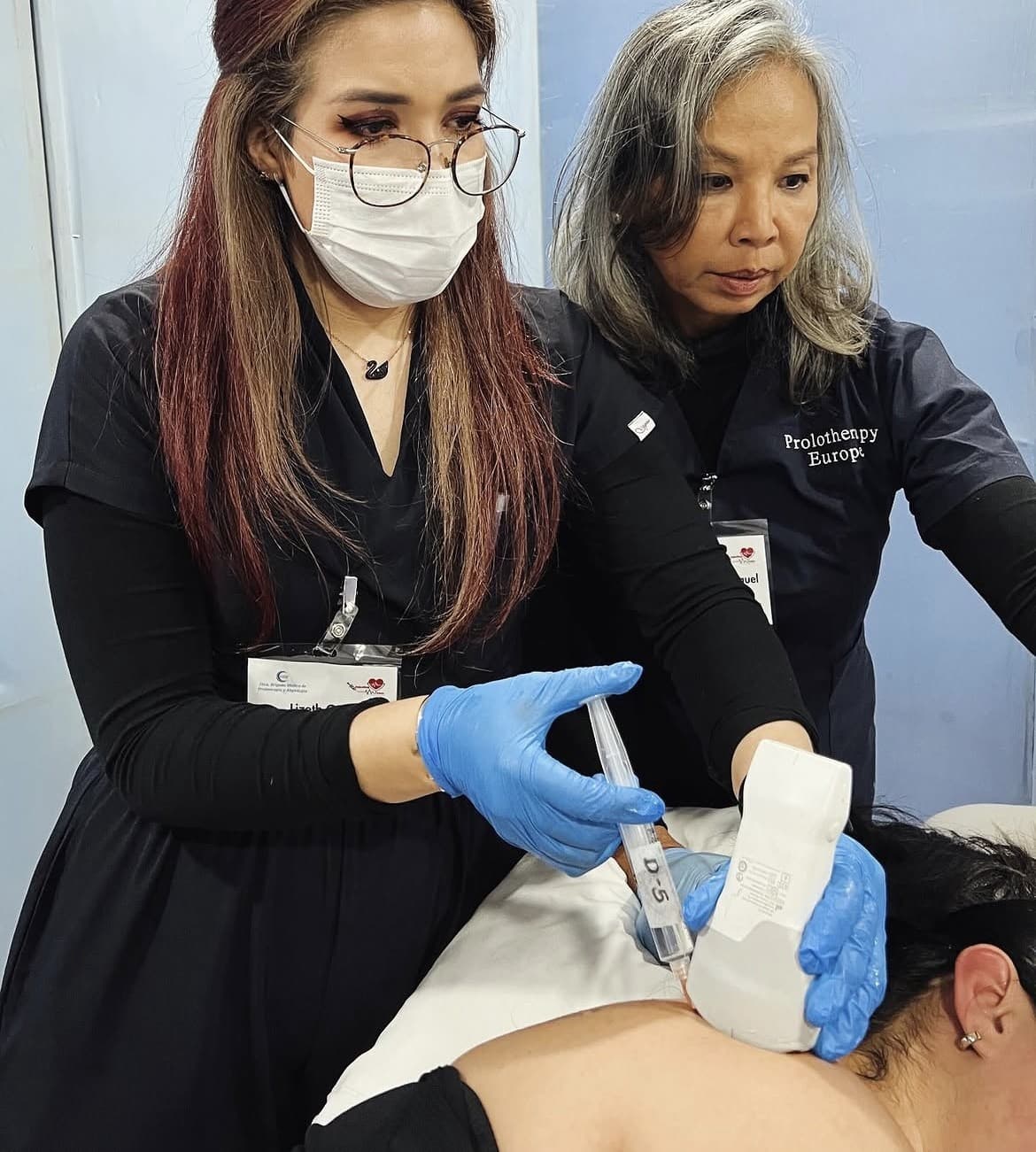
Ultrasound lets us see the target tissue in real time — tendon, ligament, bursa, joint or nerve — and guide the needle with precision. This is not surgery. It is indicated only after a medical evaluation.
What it is
An ultrasound-guided injection is a minimally invasive procedure: a medication or therapeutic solution is placed at a specific anatomic point under live ultrasound.
In Dr. Ortiz’s practice it is part of MSK intervention and of regenerative protocols (prolotherapy, viscosupplementation, growth factors or other solutions, depending on the case).
The clinical goal is not “to give a shot”. It is to place the stimulus or the drug where the tissue needs it, with as little trauma as possible to nearby structures.
Why ultrasound
Without imaging, an injection is guided by surface landmarks. With ultrasound:
- The target tissue is identified (for example, an enthesis, a bursa or the joint recess).
- Vessels, nerves and planes that should not be punctured are avoided whenever possible.
- The treated point is documented and can be correlated with the clinical findings.
Training in MSK ultrasound of the upper and lower limbs (Sonoskills) is part of the background for this work.
When it may be considered
After history, examination and, when needed, imaging. Common examples in the consultation:
- Knee, shoulder or hip joint pain
- Tendinopathy, bursitis and plantar fasciitis
- Ligament injuries and instability
- Low back, neck or transitional pain with a mechanical component
- Radiculopathy or referred pain in selected patients
- Osteoarthritis and wear in which a regenerative or viscosupplementation protocol is considered
Each indication depends on the diagnosis, not on an isolated symptom.
How it is done
Assessment
The reason for the visit is reviewed, the area is examined and we decide whether ultrasound adds useful information that day.
Localization
The probe identifies the target structure and the approach is planned.
Targeted application
The indicated solution (proliferant, hyaluronic acid, local anesthetic or another, according to the plan) is placed under ultrasound guidance.
Aftercare
Care, allowed activity and when to return for reassessment are explained. The number of sessions is not fixed.
Local anesthetic is used to reduce discomfort. You may still feel pressure, contact or mild discomfort. Details are in the FAQ.
Ultrasound-guided hydrodissection
Hydrodissection is an interventional technique. A solution is used to open a plane and mechanically separate a nerve or other structure that is compressed or adherent. In many cases that compression happens when the nerve crosses a fascial plane and produces a deep pain.
It is offered in consultation. It is a technique, not a cure for sciatica or neuropathy. Not every tingling or radiating pain is a candidate. It is linked to the assessment of radiculopathy and of compression neuropathies (including home-office postures).
Related procedures
Ultrasound guidance is not a separate treatment: it is how other procedures in the practice are applied.
Before and after
Before the procedure, let us know which medications you take (especially blood thinners), and whether you have a bleeding disorder or allergies.
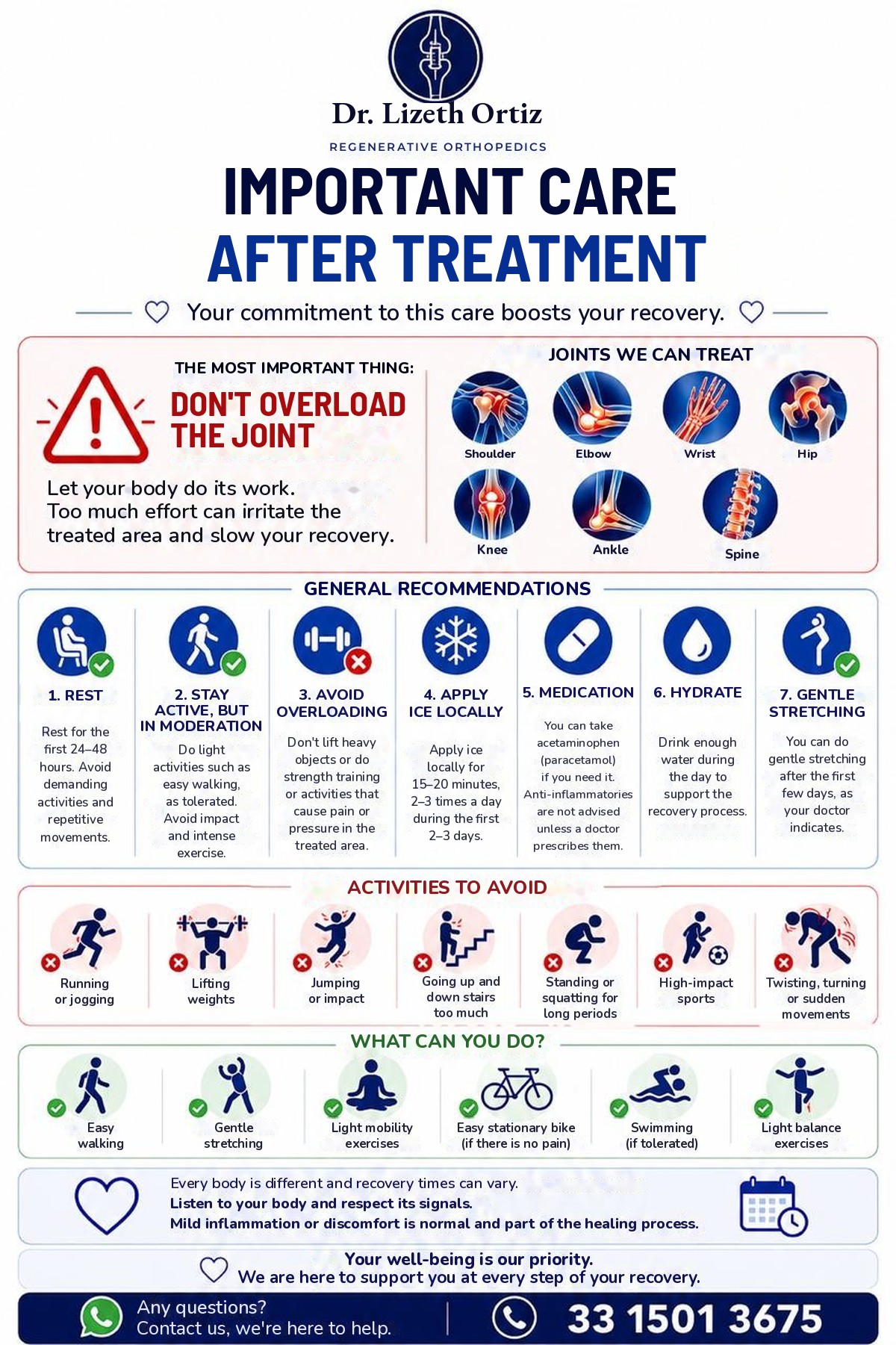
Afterward, the most important thing is not to overload the joint: too much effort can irritate the treated area and slow recovery.
- Rest for the first 24–48 hours. Avoid demanding activities and repetitive movements.
- Stay active, but in moderation: light activities such as easy walking, as tolerated.
- Avoid overloading the area: lifting weights, strength training, running, jumping or impact, going up and down stairs too much, standing or squatting for long periods, high-impact sports, and twisting or sudden movements.
- Apply ice locally for 15–20 minutes, 2–3 times a day during the first 2–3 days.
- You can take acetaminophen (paracetamol) if you need it. Anti-inflammatories are not recommended unless a doctor indicates them.
- Drink enough water during the day.
- After the first few days, gentle stretching as your doctor indicates, and, if there is no pain, a stationary bike at an easy pace, swimming, and light mobility and balance exercises.
A mild inflammation or discomfort is normal. Every body is different and recovery times vary. If fever, redness, significant warmth or swelling appear, or severe pain that gets worse as the days go by, seek medical attention right away.
In short, in an infographic by Dr. Lizeth Ortiz:
 View larger
What this procedure does not promise
Results vary. Not everyone is a candidate. Guiding with ultrasound improves the precision of the procedure. It does not guarantee relief and does not always replace surgery, rehabilitation or management of the underlying condition. Expectations, risks and alternatives are reviewed in the consultation.
Frequently asked questions
Does the injection hurt?
Local anesthetic is used to reduce discomfort during the procedure. Even so, you may feel pressure, contact or mild discomfort. Before starting, we explain what you may feel and what aftercare to follow. Ultrasound allows the procedure to be done with greater precision, although it does not completely remove the sensation of the needle.
Why do you use ultrasound?
Ultrasound makes it possible to see the structure being treated and to guide the needle with greater precision. It helps the procedure be performed more safely and accurately.
What is hydrodissection and when can it help?
Hydrodissection is an ultrasound-guided technique. A solution is used to gently separate a nerve from the tissues around it when there is compression, adhesion or irritation. By freeing the space around the nerve, the aim is to reduce pressure and make it easier for the nerve to move. This may help ease pain, tingling or other discomfort related to nerve irritation. It may be considered in some cases of entrapment or irritation of peripheral nerves. That is always after the cause and the site of the problem have been identified. Not every case of sciatica requires hydrodissection, because treatment depends on the origin of the symptoms and on each patient’s evaluation.
What imaging do I need for the evaluation?
Ideally, X-rays of the painful area (knee, hip, shoulder, spine or other) taken within the last year. If you already have an MRI or ultrasound, those help too: share them on WhatsApp before your visit. If you do not have recent imaging, we tell you which studies to get before booking.
How much does the consultation cost? And the treatment?
The evaluation visit costs MXN $500 (Mexican pesos). Treatment (prolotherapy, viscosupplementation, injections or another procedure) has no fixed price: it depends on the area, the procedure and the number of sessions you need, which are decided at your evaluation. Before starting, we tell you the cost of your plan.
Book a visit
Care in Guadalajara and Mexico City, by appointment.
Guadalajara: Bari Medical Center, San Juan de Los Lagos 21, Vallarta Poniente, 44110 Guadalajara, Jalisco, Mexico. Monday through Saturday.
Mexico City: Medical San Francisco, Rosa María Siqueiros 229, San Francisco Culhuacán, Coyoacán, 04420 Mexico City, Mexico. One week a month; ask us for the dates on WhatsApp.
You don't need imaging to message us; if you need any, we'll tell you which.
Want to tell us about your case first? Answer a few questions about your pain