Treatments
Ultrasound-guided arthrocentesis
Removing fluid from a joint, for diagnosis and relief, with ultrasound guidance.
You don't need imaging to message us; if you need any, we'll tell you which. Or tell us about your pain first
Arthrocentesis is a minimally invasive procedure that removes synovial fluid from inside a joint, for diagnostic and/or therapeutic purposes. It is performed with ultrasound guidance for greater precision and safety. It is not surgery. It does not replace an evaluation.
What it is for
- Diagnosis: allows analysis of the synovial fluid (infection, crystals, blood, etc.).
- Symptom relief: reduces pressure inside the joint, pain and inflammation.
- Better function: allows more mobility and comfort.
- Joint preparation: can be part of the care before other regenerative therapies (injections, prolotherapy, viscosupplementation).
When it is indicated
- Joint effusion (fluid buildup)
- Persistent pain and inflammation
- Suspected infection
- Suspected crystals (gout or pseudogout)
- Hemarthrosis (blood in the joint)
- Evaluation of degenerative or inflammatory joint disease
It can be done in the knee, hip, shoulder, ankle, elbow and wrist. More about knee, shoulder and hip pain.
What synovial fluid shows
- Signs of infection (cell count, culture)
- Crystals (gout or pseudogout)
- Blood (hemarthrosis)
- Degree of inflammation
- Viscosity and color
Why with ultrasound
Ultrasound shows the needle and the joint in real time, instead of relying only on external landmarks. It identifies the fluid and how much there is, makes entry into the joint more precise, lowers the risk of injuring nearby structures (tendons, cartilage, blood vessels) and allows a more complete aspiration.
How it is done
Preparation
Skin cleaning and antisepsis, and local anesthesia.
Locating
Ultrasound shows where the fluid is (in the knee, the suprapatellar recess).
Needle
The needle is inserted under real-time guidance.
Aspiration
The synovial fluid is removed.
Analysis
The fluid is analyzed in a laboratory.
If the plan calls for it, prolotherapy can be applied in the same visit.
Before and after
Before the procedure, let us know which medications you take (especially blood thinners), and whether you have a bleeding disorder or allergies.
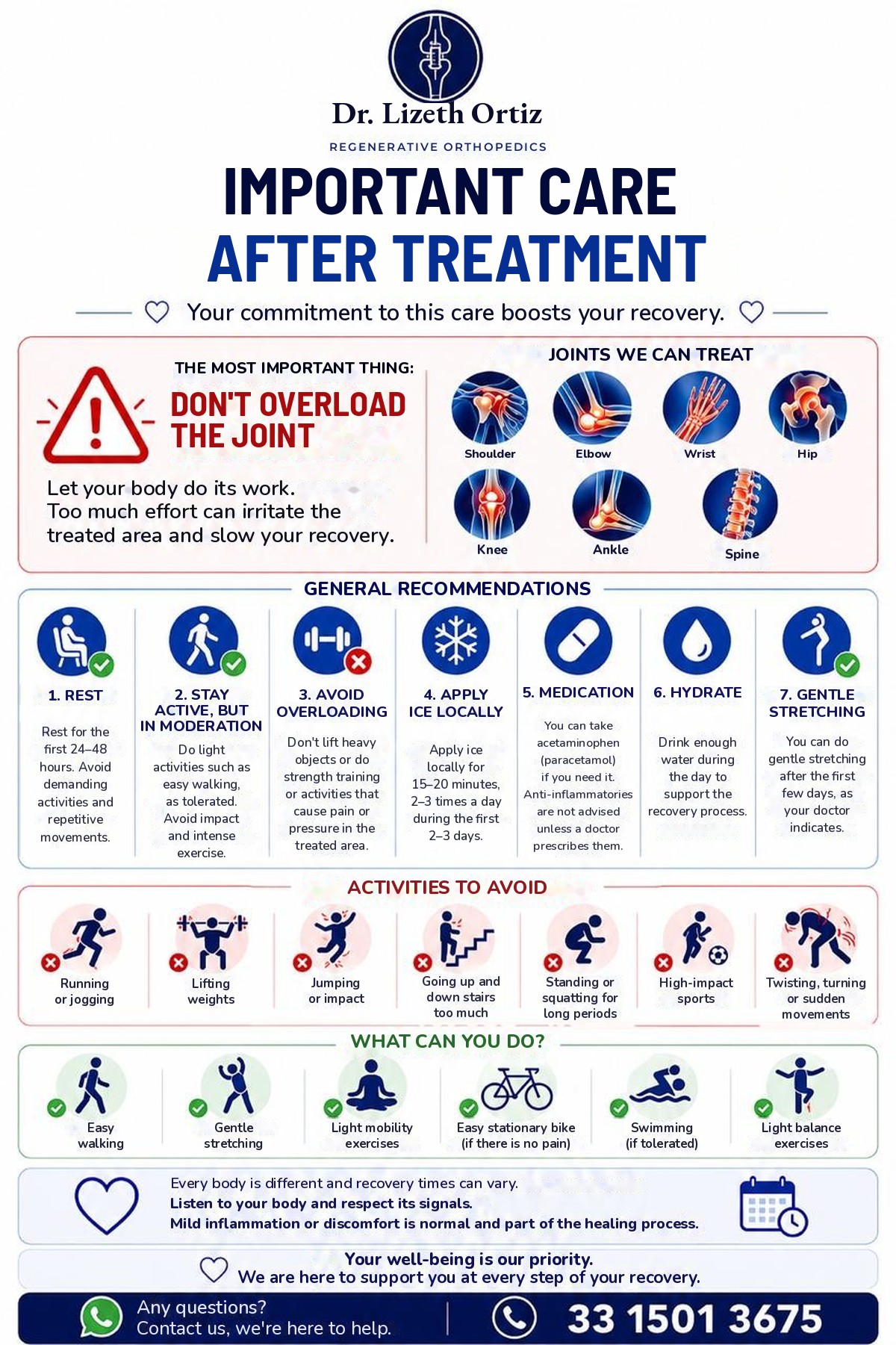
Afterward, the most important thing is not to overload the joint: too much effort can irritate the treated area and slow recovery.
- Rest for the first 24–48 hours. Avoid demanding activities and repetitive movements.
- Stay active, but in moderation: light activities such as easy walking, as tolerated.
- Avoid overloading the area: lifting weights, strength training, running, jumping or impact, going up and down stairs too much, standing or squatting for long periods, high-impact sports, and twisting or sudden movements.
- Apply ice locally for 15–20 minutes, 2–3 times a day during the first 2–3 days.
- You can take acetaminophen (paracetamol) if you need it. Anti-inflammatories are not recommended unless a doctor indicates them.
- Drink enough water during the day.
- After the first few days, gentle stretching as your doctor indicates, and, if there is no pain, a stationary bike at an easy pace, swimming, and light mobility and balance exercises.
A mild inflammation or discomfort is normal. Every body is different and recovery times vary. If fever, redness, significant warmth or swelling appear, or severe pain that gets worse as the days go by, seek medical attention right away.
In short, in an infographic by Dr. Lizeth Ortiz:
 View larger
What it does not promise
Removing the fluid brings relief, but on its own it does not treat the cause of the effusion, and the fluid can build up again; that is why it goes with a plan for the cause. It does not replace surgery when surgery is already indicated. Results vary with the cause and the condition of the joint.
Frequently asked questions
Does the injection hurt?
Local anesthetic is used to reduce discomfort during the procedure. Even so, you may feel pressure, contact or mild discomfort. Before starting, we explain what you may feel and what aftercare to follow. Ultrasound allows the procedure to be done with greater precision, although it does not completely remove the sensation of the needle.
What imaging do I need for the evaluation?
Ideally, X-rays of the painful area (knee, hip, shoulder, spine or other) taken within the last year. If you already have an MRI or ultrasound, those help too: share them on WhatsApp before your visit. If you do not have recent imaging, we tell you which studies to get before booking.
Do I have to come in to find out whether this treatment is right for me?
Not necessarily. We know that getting around can be hard when you are in pain or have limited mobility. With your symptoms and your imaging, we can guide you on WhatsApp about whether a visit makes sense. That guidance is not a consultation or a diagnosis: the treatment decision is made at the consultation, after the physical exam.
Are results guaranteed?
No. Results vary depending on the person, the tissue and what has already been tried. Expectations are reviewed honestly during the consultation.
How much does the consultation cost? And the treatment?
The evaluation visit costs MXN $500 (Mexican pesos). Treatment (prolotherapy, viscosupplementation, injections or another procedure) has no fixed price: it depends on the area, the procedure and the number of sessions you need, which are decided at your evaluation. Before starting, we tell you the cost of your plan.
Further reading
Book a visit
Care in Guadalajara and Mexico City, by appointment.
Guadalajara: Bari Medical Center, San Juan de Los Lagos 21, Vallarta Poniente, 44110 Guadalajara, Jalisco, Mexico. Monday through Saturday.
Mexico City: Medical San Francisco, Rosa María Siqueiros 229, San Francisco Culhuacán, Coyoacán, 04420 Mexico City, Mexico. One week a month; ask us for the dates on WhatsApp.
You don't need imaging to message us; if you need any, we'll tell you which.
Want to tell us about your case first? Answer a few questions about your pain