Blog
Physical therapies and inflammation: what we know about M2 macrophages
In the lab, therapies such as shock waves, laser or heat change how macrophages, the cells that direct inflammation and repair, behave. In patients, something else has been measured: pain and function. Here we keep the two apart.
Inflammation as part of repair
When a muscle, tendon or ligament is injured, inflammation is the first step of repair, not a mistake by the body. Defense cells called macrophages arrive and play two roles:
- M1: clean up. They arrive first, remove damaged tissue and defend against infection. They produce the substances that cause inflammation.
- M2: rebuild. They calm inflammation and support the cells that rebuild the tissue.
In injured muscle, inflammatory macrophages were seen to switch to the second form, and that switch supports regeneration. Splitting them into two types is a simplification: in the body there is a whole range between one and the other. The point is not to switch inflammation off, but for it to do its job and end on time.
Where the evidence comes from
Almost everything known about the effect of physical therapies on macrophages comes from cultured cells or animals. In patients, macrophages are not measured: what is measured is whether pain goes down and function improves. That is why the table keeps the two apart.
| In the lab or in animals | In patients | |
|---|---|---|
| Shock waves | In cultured human macrophages, at low energy, they curbed M1 markers and increased M2 markers. | Plantar fasciitis: effective and well tolerated for pain. Rotator cuff tendinopathy: limited evidence in favor, for pain and function. |
| Low-level laser (“cold laser”) | In cultured mouse macrophages, red or infrared light lowered inflammatory substances from M1 cells. | Knee osteoarthritis: in placebo-controlled trials, less pain and disability at recommended doses; at lower doses, little or no effect. |
| Therapeutic ultrasound | In mice with a bruised muscle, low-intensity pulsed ultrasound improved recovery and shifted macrophages from M1 to M2. | Knee osteoarthritis: may help with pain and function, with low-quality evidence. Recent fractures: low-intensity pulsed ultrasound does not improve what matters to patients. |
| Pulsed electromagnetic fields (magnetotherapy) | In culture, the effect depended on the type of field: one made macrophages more inflammatory and another led them to stimulate bone-forming cells. | Osteoarthritis: may relieve pain moderately; it is unclear whether it improves function. |
| Hyperbaric oxygen | In rats with spinal cord injury, more M2 and fewer M1. | Ankle sprain or knee ligament injury: the studies are not enough to know whether it helps. Muscle soreness after unaccustomed exercise: it did not help, and there was slightly more pain. |
| Heat | In rats, after cutting the Achilles tendon, heat reduced inflammation and M1 and increased M2 in one of the two muscles studied. | Acute or subacute low back pain: a heat wrap slightly reduced pain and disability in the short term; more so when exercise is added. |
| Cold | It reduced M1 without changing M2. Its effect on repair depends on the injury and the timing (see below). | Used to relieve pain. There is not enough evidence that it improves recovery; only a marginal benefit of ice with exercise in ankle sprain and after surgery. |
| TENS (electrical stimulation for pain) | Very little: one recent study in animals with pelvic pain (a prostatitis model) found more M2. | Lowers pain during use or right after. Its role is pain relief, not repair. |
A caveat about cold
Ice is one of the most common measures after a knock or a sprain. In animals, its effect on repair depends on the injury: after a large muscle injury, applied immediately it delayed the arrival of macrophages and regeneration; applied later, the macrophages arrived on time. In small injuries, on the other hand, it favored regeneration.
In people it is not yet known whether the same happens. Today its role is relieving pain, not speeding up repair.
What it means in practice
- Shock waves for plantar fasciitis and low-level laser for knee osteoarthritis, at the right dose, are among those with the clearest results in patients.
- TENS and heat relieve pain for a while, and cold is used for the same purpose. With less pain, it is easier to move and exercise.
- What was seen in macrophages helps explain why they might favor repair, but it has not yet been proven to happen in patients.
- None of them replaces a diagnosis or the exercise indicated for your case.
Before using them, ask first if…
- You have a pacemaker or another implanted electronic device. TENS and electromagnetic fields can interfere with it.
- You are pregnant. Several of these therapies are not used during pregnancy or are not applied over the abdomen and pelvis.
- You have reduced skin sensation (for example, from diabetes). Heat and cold can hurt you without you feeling it.
- You take blood thinners or have a clotting problem. Shock waves can cause bruising or bleeding.
- You have cancer or an infection in the area. Most of these therapies are not applied there.
- You are offered hyperbaric oxygen. It needs a medical indication and an ear and lung check before starting.
If you are offered any of these therapies, ask what result to expect, after how many sessions, and how its effect will be measured.
In summary
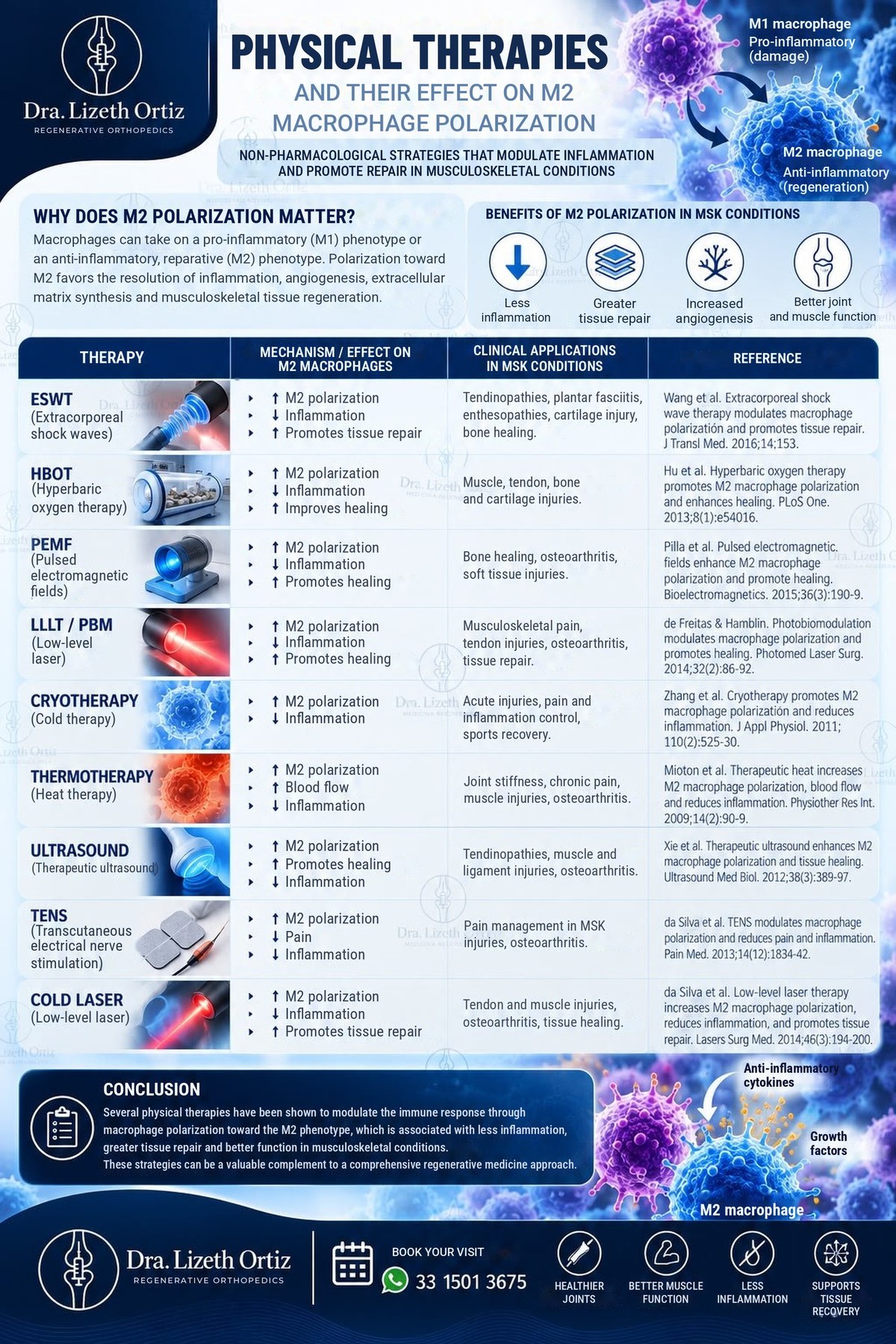
The therapies in this article, in a slide prepared by Dr. Lizeth Ortiz. What has been proven in patients is detailed in the sections above.
 View larger
How it fits with treatment
Tissue repair happens in phases and takes time (we explain it in Repair is not instant). Physical therapies can accompany a plan with prolotherapy, viscosupplementation or ultrasound-guided injections, but they do not replace a diagnosis. If you have knee, spine, shoulder, hip or heel pain, the first step is knowing which tissue hurts and why.
Educational. Physical therapies can be a support, but they do not replace an individual medical evaluation. Results vary.
References (26)
- Arnold L, et al. Inflammatory monocytes recruited after skeletal muscle injury switch into antiinflammatory macrophages to support myogenesis. J Exp Med. 2007;204(5):1057-1069. Read the source
- Murray PJ, et al. Macrophage activation and polarization: nomenclature and experimental guidelines. Immunity. 2014;41(1):14-20. Read the source
- Sukubo NG, et al. Effect of shock waves on macrophages: a possible role in tissue regeneration and remodeling. Int J Surg. 2015;24(Pt B):124-130. Read the source
- Efficacy and tolerability of extracorporeal shock wave therapy in patients with plantar fasciopathy: a systematic review with meta-analysis and meta-regression. Eur J Phys Rehabil Med. 2024;60(5):832-846. Read the source
- Xue X, et al. Effect of extracorporeal shockwave therapy for rotator cuff tendinopathy: a systematic review and meta-analysis. BMC Musculoskelet Disord. 2024;25:357. Read the source
- de Brito Sousa K, et al. Differential expression of inflammatory and anti-inflammatory mediators by M1 and M2 macrophages after photobiomodulation with red or infrared lasers. Lasers Med Sci. 2020;35:337-343. Read the source
- Stausholm MB, et al. Efficacy of low-level laser therapy on pain and disability in knee osteoarthritis: systematic review and meta-analysis of randomised placebo-controlled trials. BMJ Open. 2019;9:e031142. Read the source
- Qin H, et al. Low-intensity pulsed ultrasound promotes skeletal muscle regeneration via modulating the inflammatory immune microenvironment. Int J Biol Sci. 2023;19:1123. Read the source
- Rutjes AWS, et al. Therapeutic ultrasound for osteoarthritis of the knee or hip. Cochrane Database Syst Rev. 2010. Read the source
- Schandelmaier S, et al. Low intensity pulsed ultrasound for bone healing: systematic review of randomized controlled trials. BMJ. 2017;356:j656. Read the source
- Chen Y, et al. Modulation of macrophage activity by pulsed electromagnetic fields in the context of fracture healing. Bioengineering. 2021;8(11):167. Read the source
- Li S, et al. Electromagnetic fields for treating osteoarthritis. Cochrane Database Syst Rev. 2013. Read the source
- Geng CK, et al. The effects of hyperbaric oxygen on macrophage polarization after rat spinal cord injury. Brain Res. 2015;1606:68-76. Read the source
- Bennett M, et al. Hyperbaric oxygen therapy for delayed onset muscle soreness and closed soft tissue injury. Cochrane Database Syst Rev. 2005. Read the source
- Hirunsai M, Srikuea R. Heat stress ameliorates tenotomy-induced inflammation in muscle-specific response via regulation of macrophage subtypes. J Appl Physiol. 2020;128(3):612-626. Read the source
- French SD, et al. Superficial heat or cold for low back pain. Cochrane Database Syst Rev. 2006. Read the source
- Miyazaki A, et al. Icing after skeletal muscle injury decreases M1 macrophage accumulation and TNF-α expression during the early phase of muscle regeneration in rats. Histochem Cell Biol. 2023;159:77-89. Read the source
- Takagi R, et al. Influence of icing on muscle regeneration after crush injury to skeletal muscles in rats. J Appl Physiol. 2011;110(2):382-388. Read the source
- Immediate icing disrupts the very early MCP-1/CCR2 recruitment window and delays muscle regeneration in rats. Am J Physiol Cell Physiol. 2026. Read the source
- Nagata I, et al. Icing after skeletal muscle injury with necrosis in a small fraction of myofibers limits inducible nitric oxide synthase-expressing macrophage invasion and facilitates muscle regeneration. Am J Physiol Regul Integr Comp Physiol. 2023;324:R574-R588. Read the source
- Bleakley C, McDonough S, MacAuley D. The use of ice in the treatment of acute soft-tissue injury: a systematic review of randomized controlled trials. Am J Sports Med. 2004;32(1):251-261. Read the source
- Hong T, et al. TENS alleviates CP/CPPS-related inflammation and pain by modulating Kir2.1-dependent macrophage polarization. Front Immunol. 2026;16:1683500. Read the source
- Johnson MI, et al. Efficacy and safety of transcutaneous electrical nerve stimulation (TENS) for acute and chronic pain in adults: a systematic review and meta-analysis of 381 studies (the meta-TENS study). BMJ Open. 2022;12:e051073. Read the source
- Houghton PE, Nussbaum EL, Hoens AM. Electrophysical agents. Contraindications and precautions: an evidence-based approach to clinical decision making in physical therapy. Physiother Can. 2010;62(5):1-80. Read the source
- Auersperg V, Trieb K. Extracorporeal shock wave therapy: an update. EFORT Open Rev. 2020;5(10). Read the source
- Heyboer M, et al. Hyperbaric oxygen therapy: side effects defined and quantified. Adv Wound Care. 2017;6(6):210-224. Read the source
Dr. Lizeth shares more about joint pain and regenerative medicine on social media.
Book a visit
Care in Guadalajara and Mexico City, by appointment.
Guadalajara: Bari Medical Center, San Juan de Los Lagos 21, Vallarta Poniente, 44110 Guadalajara, Jalisco, Mexico. Monday through Saturday.
Mexico City: Medical San Francisco, Rosa María Siqueiros 229, San Francisco Culhuacán, Coyoacán, 04420 Mexico City, Mexico. One week a month; ask us for the dates on WhatsApp.
Want to tell us about your case first? Answer a few questions about your pain