
Blog
Supplements for joint pain: what the evidence says
Some supplements have been studied in people with joint pain. Many others have only been tested in the lab. Knowing the difference keeps you from paying for what does not help and from taking needless risks.
Before you start
Supplements can be a support. They do not cure osteoarthritis, they do not repair a meniscus or a tendon on their own, and they do not replace an evaluation. What some of them can do, in some people, is help with pain or stiffness as part of a plan.
Where the evidence comes from also matters. An effect seen in cartilage cells in a lab does not guarantee the same effect in a knee. That is why we sort them into three groups here.
Studied in people with joint pain
- Collagen. It is the main protein in cartilage, tendons and ligaments; it is used to support their elasticity and strength. A meta-analysis of 11 trials with 870 people with knee osteoarthritis found improvement in pain and function compared with placebo. The authors call for longer studies to confirm it.
- Curcumin (turmeric). It has anti-inflammatory properties and is used for joint pain and stiffness. Several reviews of clinical trials show less pain and better function in knee osteoarthritis compared with placebo. Study quality varies.
- Ginger. It is anti-inflammatory and belongs to the same family as turmeric. In a trial with 247 people with knee osteoarthritis, the extract reduced pain on standing and after walking. The effect was moderate.
- Omega-3. It has an anti-inflammatory effect and supports heart health and muscle function. A meta-analysis of 9 trials with more than 2,000 people with osteoarthritis found a small reduction in pain. Other studies find no difference, so the effect, if any, is modest.
- PEA (palmitoylethanolamide). The body makes it to regulate pain and inflammation. There are placebo-controlled trials in pain, including one from 2026 in knee osteoarthritis. It is among those with the most recent evidence.
- Vitamin D. It is essential for bone, muscle function and the immune system. As a supplement for pain, results are mixed: it helps mainly when there is a deficiency, and in back pain or musculoskeletal pain without a deficiency, several studies find no effect. It is worth measuring your levels before supplementing.
Promising, but so far only in the lab
These have studies in cells or animals showing anti-inflammatory or antioxidant effects, but they do not yet have enough studies in patients with joint pain:
- Green tea extract. Rich in antioxidant polyphenols. In cartilage cells it curbed the substances that inflame and break down cartilage.
- Resveratrol. An antioxidant found in grapes and berries. In the lab it blocked inflammation pathways in cartilage cells.
- Pterostilbene. A relative of resveratrol, found in blueberries. In the lab it reduced inflammation and cartilage breakdown.
- Sulforaphane. Comes from broccoli. Antioxidant and anti-inflammatory; in cells it helped protect cartilage.
- Berberine. Anti-inflammatory. In animals it limited joint damage and pain after an injury. In people it is studied mostly for blood sugar.
- Astaxanthin. A potent antioxidant from algae, salmon and shrimp. It is being studied to protect muscle and cartilage from oxidative stress.
- N-acetylcysteine (NAC). An antioxidant; it helps the body make glutathione, its own protection against oxidative stress.
- Polyphenols. Antioxidant and anti-inflammatory compounds in fruit, vegetables, tea and cocoa.
- Beta-glucans. Come from mushrooms, oats and yeast; they modulate the immune response.
Working in the lab is a good starting point. It is not proof that they will help your joint.
Nutrition that supports the body in general
- Magnesium. It takes part in muscle and nerve function and in bone health. It is widely used for cramps, although studies only show a clear benefit when it is lacking.
- Zinc. It plays a role in tissue repair and immune function. It helps when it is lacking; if your levels are normal, taking more adds nothing.
- Fiber and probiotics. They support gut health and are linked to lower overall inflammation. In joint pain there are only very small studies: one, with four people, combined probiotics and PEA.
A varied diet with vegetables, fruit, fish and enough protein covers much of this.
Before taking any of them, ask first if…
- You take blood thinners or antiplatelet drugs (warfarin, daily aspirin and others). Curcumin and omega-3 can increase the risk of bleeding.
- You have diabetes. Berberine lowers blood sugar and can add to your medication. It also changes how the body processes other drugs.
- You plan to take green tea extract. Concentrated capsules have been linked to liver damage, especially at high doses (800 mg or more of EGCG a day) or on an empty stomach. Green tea by the cup does not have this problem.
- Your curcumin contains black pepper (piperine). Piperine greatly increases absorption, and liver damage has been reported with that combination.
- You take vitamin D on your own. Adults should not exceed 4,000 IU a day unless a doctor indicates it. Too much raises calcium and can damage the kidneys.
- You are pregnant, breastfeeding or have surgery coming up.
Bring to your visit the list of supplements you take, with the name and dose from the label.
In summary
The supplements in this article, in two slides prepared by Dr. Lizeth Ortiz. The level of evidence for each one is detailed in the sections above.
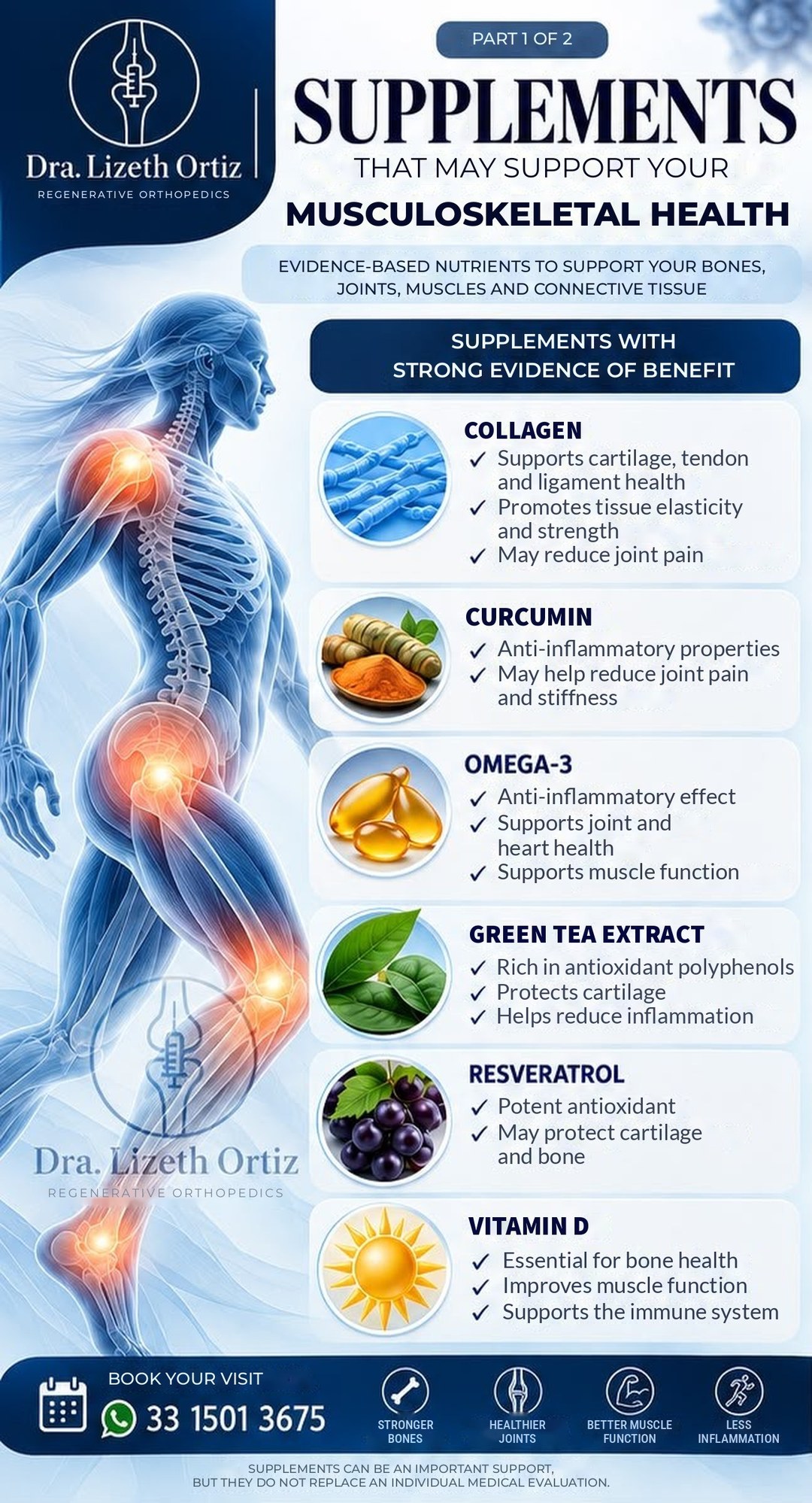 Slide 1 of 2
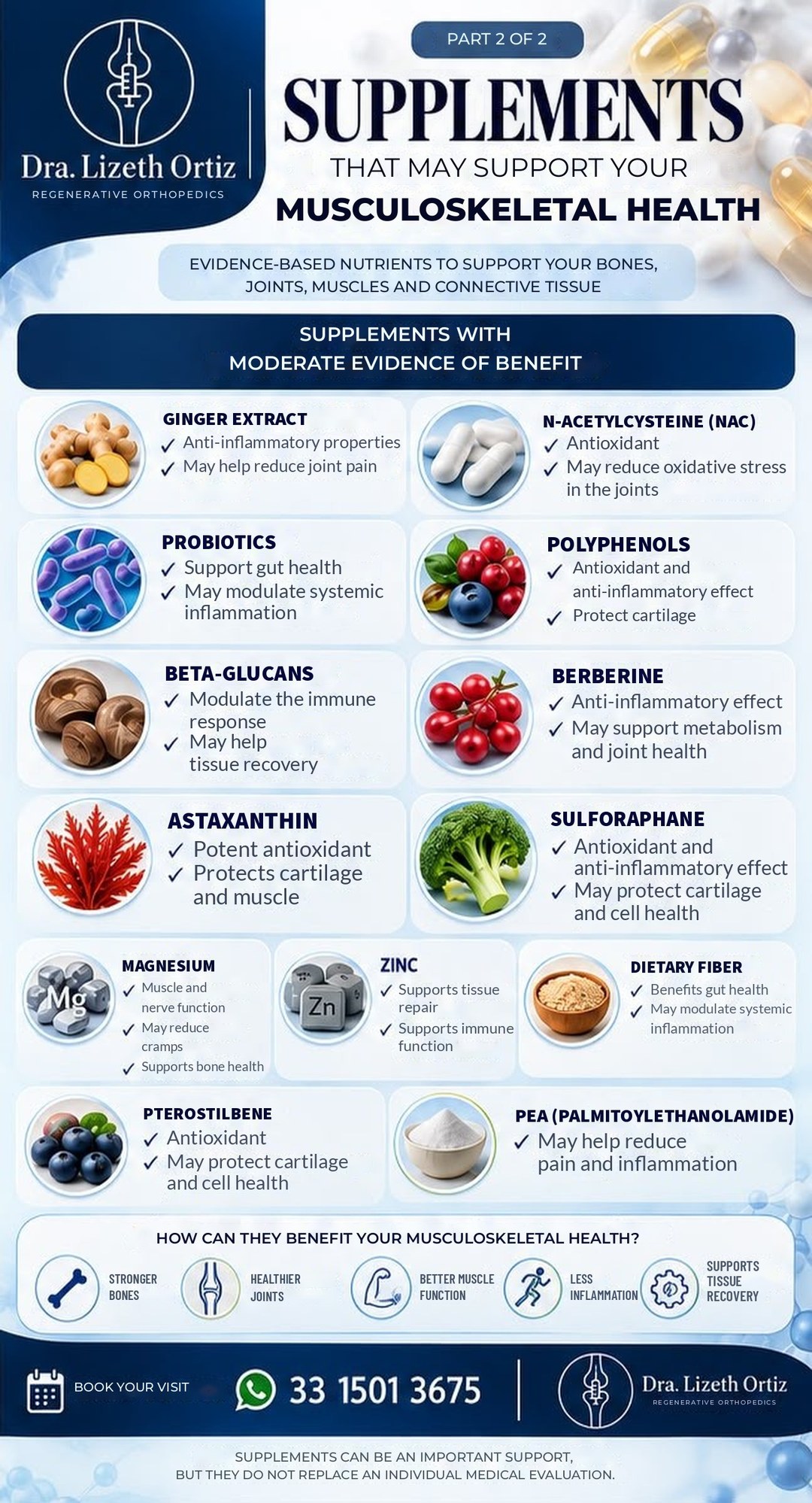 Slide 2 of 2
How it fits with treatment
A supplement can accompany a plan with prolotherapy, viscosupplementation or ultrasound-guided injections, but it does not replace a diagnosis. If you have knee, spine, shoulder or hip pain, the first step is knowing which tissue hurts and why.
Educational. Supplements can be a support, but they do not replace an individual medical evaluation. Results vary.
References (15)
- Simental-Mendía M, et al. Effect of collagen supplementation on knee osteoarthritis: an updated systematic review and meta-analysis of randomised controlled trials. Clin Exp Rheumatol. 2025. Read the source
- Efficacy and safety of curcuminoids alone in alleviating pain and dysfunction for knee osteoarthritis: a systematic review and meta-analysis of randomized controlled trials. 2022. Read the source
- Altman RD, Marcussen KC. Effects of a ginger extract on knee pain in patients with osteoarthritis. Arthritis Rheum. 2001;44(11):2531-2538. Read the source
- Effect of omega-3 polyunsaturated fatty acids supplementation for patients with osteoarthritis: a meta-analysis. J Orthop Surg Res. 2023. Read the source
- Palmitoylethanolamide supplementation for human health: a state-of-the-art systematic review of randomized controlled trials in patient populations. 2024. Read the source
- Temporal effects of palmitoylethanolamide (PEA) in modulating knee osteoarthritis symptoms: a randomized, double-blind, placebo-controlled trial. 2026. Read the source
- Does vitamin D supplementation alleviate chronic nonspecific musculoskeletal pain? A systematic review and meta-analysis. 2016. Read the source
- Effect of vitamin D supplementation in chronic widespread pain: a systematic review and meta-analysis. Clin Rheumatol. 2017. Read the source
- Comblain F, et al. Curcuminoids extract, hydrolyzed collagen and green tea extract synergically inhibit inflammatory and catabolic mediator's synthesis by normal bovine and osteoarthritic human chondrocytes in monolayer. PLoS One. 2015. Read the source
- Probiotics and palmitoylethanolamide (PEA) for osteoarthritic pain: individual effects in a multiple baseline design study. BMC Complement Med Ther. 2026. Read the source
- United States Pharmacopeia (USP). Comprehensive review of the hepatotoxicity of green tea extracts. Toxicol Rep. Read the source
- EFSA Panel on Food Additives and Nutrient Sources added to Food. Scientific opinion on the safety of green tea catechins. EFSA Journal. 2018. Read the source
- Medsafe (New Zealand). Turmeric/curcumin containing products can interact with warfarin. 2018. Read the source
- Drug-induced liver injury secondary to turmeric supplement containing piperine: a case report. 2025. Read the source
- NIH Office of Dietary Supplements. Vitamin D: Fact Sheet for Health Professionals. Read the source
Dr. Lizeth shares more about joint pain and regenerative medicine on social media.
Book a visit
Care in Guadalajara and Mexico City, by appointment.
Guadalajara: Bari Medical Center, San Juan de Los Lagos 21, Vallarta Poniente, 44110 Guadalajara, Jalisco, Mexico. Monday through Saturday.
Mexico City: Medical San Francisco, Rosa María Siqueiros 229, San Francisco Culhuacán, Coyoacán, 04420 Mexico City, Mexico. One week a month; ask us for the dates on WhatsApp.
Want to tell us about your case first? Answer a few questions about your pain